Birds are nature’s living rainbows, adorning forests, wetlands, and skies with hues that range from fiery reds to iridescent blues. With an estimated 10,000 bird species worldwide, these feathered wonders never fail to captivate with their vivid plumage and unique behaviors. Below, discover 26 of the most colorful birds on the planet, each with distinct traits, habitats, and charm that make them stand out in the avian world.
Wilson’s Bird-of-Paradise (Diphyllodes respublica)
Renowned for its striking blue “bonnet” crown—actually bare skin crisscrossed with black feathers—Wilson’s bird-of-paradise is a feast for the eyes. Its colorful ensemble includes a yellow nape, red back, green breast, violet feet, and long violet-blue tail feathers that split into two spirals, with light yellow inside its mouth. The blue, green, and violet hues stem from structural color, which shines brightest in the right light. Found in the lowland rainforests of Eastern Indonesia, Australia, and Papua New Guinea, this species feeds on fruits and insects. Males perform an elaborate mating ritual: they clean their territory of debris before calling mates and displaying their feathers in a courtship dance.
Red-necked Tanager (Tangara cyanocephala)
A standout in Eastern South America’s treetops, the red-necked tanager lives up to its name with a bright red neck that resembles a scarf. Its vibrant plumage also features bright green underparts, yellowish-orange wings with black accents, and a brilliant blue-violet crown and throat. Males are more flashy than females, though both share similar coloring. Measuring 4 to 8 inches long and weighing just 8 grams, this monogamous bird feeds on fruits and insects and lays 2 to 4 eggs per clutch. Spotting it often requires a canopy tour in eastern Brazil, Paraguay, or northeastern Argentina.
Spangled Cotinga (Cotinga cayana)
One of the Amazon Rainforest’s most eye-catching residents, the male spangled cotinga boasts a turquoise body and deep pink or wine-colored throat. Females are more muted, with dull brown plumage and black mottling. This 7 to 8-inch bird weighs 2 to 2.5 ounces and feeds primarily on small fruits. Unlike many birds, it does not vocalize—instead, it makes a whistling sound in flight. Non-monogamous by nature, females take full responsibility for incubating 1 to 4 eggs. It is often seen perched on dead treetops, soaking up the Amazon’s sunlight.
Mandarin Duck (Aix galericulata)
A symbol of love and fidelity in Chinese, Japanese, and Korean cultures, the mandarin duck is a romantic favorite. Males flaunt a golden body, purple breast, green, blue, and white accents, creating a stunning mosaic of colors. Native to East Asia, this 16 to 18-inch bird prefers lakes and marshy areas, feeding on worms, mollusks, small fish, insects, and water plants. Males are chivalrous, guarding females while they incubate 9 to 12 eggs. Some populations have been introduced to Europe, Russia, and North America, with a famous sighting in New York’s Central Park in 2018.
Keel-billed Toucan (Ramphastos sulfuratus)
Famous from Kellogg’s Froot Loop commercials, the keel-billed toucan is the most colorful of its 40+ toucan relatives, thanks to its rainbow-colored bill (red, yellow, orange, blue, and green). Its body is mostly black, with a yellow throat and chest. This large bird measures 17 to 22 inches long, weighs 4.7 to 8.8 pounds, and has a wingspan of 43 to 60 inches. The hollow bill, up to 7 inches long, is used for sparring, attracting mates, and snatching fruit, insects, and bird eggs. Found in Southern Mexico, Venezuela, and Colombia, it lives in flocks of around 20 and sleeps in tree cavities. Monogamous pairs share parenting duties, incubating 1 to 5 eggs.
Western Crowned Pigeon (Goura cristata)
No ordinary pigeon, the western crowned (or blue-crowned) pigeon is one of the world’s most beautiful, with blue plumage, a lacy fan-like crest, and a deep blue “eye mask.” As big as a turkey, it measures 28 inches long and weighs up to 4.6 pounds. Native to Western New Guinea, it lives in small flocks in marshes and lowland rainforests, feeding on fruit, seeds, and insects. Monogamous pairs have elaborate courtship rituals: males fan their tail and wing feathers, bow, and boom, while females dance around them. They build nests together and incubate a single egg, feeding the chick with milk from partially digested food.
Lady Gouldian Finch (Erythrura gouldiae)
Also called the rainbow finch, the Lady Gouldian finch lives up to its name with red, yellow, green, blue, purple, and black block stripes. Found in northwestern Australia, this 5-inch bird weighs just 0.42 ounces and feeds on grass seeds. A fascinating biological quirk: mating two finches with different colored heads (red or black) raises offspring mortality to 80%. The birds adapt by mating with both head colors to boost survival odds. They are often seen in mixed flocks foraging across grasslands.
Common Kingfisher (Alcedo atthis)
Found worldwide near ponds, rivers, and lakes, the common kingfisher is a small dynamo with teal blue feathers and bright orange underparts—making it the most colorful of the 90+ kingfisher species. Measuring 6 to 7 inches long and weighing 1.2 to 1.6 ounces, it uses its long, dagger-like beak to dive for small fish and crustaceans. Solitary by nature, it pairs only during mating season: males offer fish to females, and accepted pairs nest in bank burrows, tree hollows, or termite mounds. Both parents brood 3 to 6 eggs and raise the chicks.
Red-bearded Bee-Eater (Nyctyornis amictus)
Standing out in Southeast Asia’s Indo-Malayan dense forests, the red-bearded bee-eater has a reddish-orange throat and chest that contrasts with its green body and pinkish-purple head. Measuring 10 to 12 inches long and weighing 2.15 to 3.25 ounces, it waits motionless for prey—bees, wasps, hornets, and other insects. Monogamous pairs nest in tunneled burrows of sandy river banks, brooding 2 to 9 eggs, with both parents feeding the chicks.
Paradise Tanager (Tangara chilensis)
A canopy gem of the Amazon Basin (Peru, Brazil, Colombia, Bolivia, Ecuador), the paradise tanager has an apple-green head, bright blue belly, and a mix of blue, yellow, and black feathers. This 5.5-inch songbird weighs 18 to 21 grams and feeds on insects like grasshoppers and spiders. It sings melodiously and lives in mixed flocks. Females build nests high in treetops from moss, grass, and spider web, while males sing nearby. They raise up to three broods per season, with 2 to 4 eggs each.
Lilac-breasted Roller (Coracias caudatus)
The unofficial national bird of Kenya and Botswana, the lilac-breasted roller is a pastel masterpiece: lilac throat and chest, blue-green head and nape, violet wings, blue underparts, and brown shoulders. Measuring 14.5 inches long and weighing 3.6 ounces, it feeds on insects, arthropods, and small rodents. Males and females look similar, and they perform impressive courtship displays—diving and rolling in the air with loud calls. Monogamous pairs nest in ready-made holes (from kingfishers or woodpeckers) and incubate 2 to 4 eggs together.
Andean Cock-of-the-Rock (Rupicola peruvianus)
Peru’s national bird, the Andean cock-of-the-rock, thrives in cloud forests of the Andes (Venezuela to Bolivia), often on rocks and ledges. Males sport bright reddish-orange head, throat, breast, and shoulders, with gray wings and black underparts; females are duller rusty brown. Measuring 13 inches long and weighing 8 ounces, it feeds on fruit and small amphibians. Highly polygamous, males spend hours strutting, head-bobbing, and wing-flapping to attract females. Females choose mates by pecking their necks and raise 2 chicks alone.
Crimson Rosella (Platycercus elegans)
A vivid parrot of Eastern and Southeastern Australia and New Zealand, the crimson rosella has a crimson red head and body, contrasting with blue throat, wings, and tail. Measuring 10 to 14 inches long and weighing 4.2 ounces, it is intelligent, playful, and noisy—chattering, squawking, and whistling. It forages in wet forests for seeds, fruit, herbs, and insects, often in flocks. Monogamous pairs nest in tree hollows during breeding season, with females incubating 3 to 8 eggs and both parents raising the chicks.
American Purple Gallinule (Porphyrio martinicus)
Hiding in reeds and aquatic vegetation around swamps and ponds of the Southeastern U.S. and Central America, the American purple gallinule is striking: iridescent violet plumage, shimmering green wings, blue head, red beak, and long yellow legs and toes (for walking on floating plants). Measuring 10 to 15 inches long and weighing 5 to 10.8 ounces, it feeds on fish, plants, fruit, and snails. Monogamous and territorial, pairs build floating nests and incubate 2 to 10 eggs.
Splendid Fairy Wren (Malurus splendens)
A charismatic resident of Australia’s shrublands and woodlands, the male Splendid Fairy Wren wears a cobalt blue, pale blue, and turquoise suit. Measuring 5.5 inches long and weighing 0.35 ounces, it charms females (brown-plumed) with pink and purple flower petals. Interestingly, both males and females practice promiscuity, and all involved birds help raise offspring. They forage in groups for seeds, fruit, and insects.
Curl-crested Aracari (Pteroglossus beauharnaesii)
This toucan of the Amazon Basin (Western Brazil, Northern Peru, Central Bolivia) stands out with black, tightly curled head feathers (resembling a 1980s Jheri curl) and a multicolored body: yellow chest, red back, dark green wings and tail, and a colorful beak. Measuring 16 to 18 inches long and weighing 6.7 to 9.9 ounces, it feeds on fruit in flocks. Monogamous pairs nest in former woodpecker hollows, sharing incubation and raising 3 to 4 eggs.
Indian Peafowl (Pavo cristatus)
No colorful bird list is complete without the Indian peafowl (peacock). Males boast a dazzling blue-green breast, golden crest, and a 5-foot tail fan of green, blue, and yellow, dotted with eyespots. Females (peahens) are brown. Native to Southeast Asia (introduced worldwide), this 3.3 to 3.8-foot bird weighs 8.8 to 13 pounds and feeds on seeds, fruit, and insects. Polygamous males display their tails to attract mates, while females nest on the ground and raise 4 to 8 chicks alone. It is India’s national bird.
Northern Cardinal (Cardinalis cardinalis)
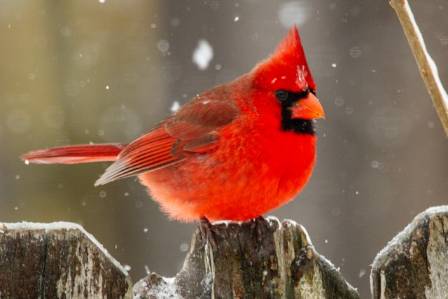
A winter favorite, the Northern Cardinal is known for its bright red plumage, red crest, and black eye mask—contrasting beautifully with snow. Native to Eastern and Central North America, this 8-inch bird weighs 1.6 ounces and feeds on seeds and insects. Named after Roman Catholic cardinals’ red robes, it is monogamous: males husk seeds for mates during breeding season. Pairs raise two broods yearly, with 3 eggs per nest, and frequent urban parks and gardens.
Painted Bunting (Passerina ciris)
Called the “rainbow bunting,” the male Painted Bunting is a riot of color: bright blue head, red underparts, yellow back, and green wings. Females are mostly green. Found in the Southeastern U.S., this 4.7 to 6-inch bird weighs 0.46 to 0.7 ounces and is shy—staying under tree cover but visiting feeders for grass seeds and insects. Seasonally monogamous, males establish territories a week before females arrive, performing courtship displays to attract mates. Females build nests of moss and grass, brooding 3 to 5 eggs.
Scarlet Macaw (Ara macao)
One of the largest and most intelligent colorful birds, the Scarlet Macaw is predominantly red, with a white face and blue, yellow, and green wings. Measuring 33 inches long and weighing 2.2 pounds, it can mimic human speech and animal sounds, and distinguish shapes and colors. Found in Central and South America, it feeds on berries, nuts, seeds, insects, and riverbank clay (to neutralize toxins). Monogamous and long-lived (50 years in the wild), pairs raise 2 to 3 chicks and do not breed again until juveniles are independent.
Resplendent Quetzal (Pharomachrus mocinno)
Sacred to ancient Aztec and Mayan cultures, the Resplendent Quetzal has metallic green-blue plumage (shifting with sunlight) and a red chest. Found in Central America’s cloud forests, this 14 to 16-inch bird weighs 6.5 to 8 ounces and feeds on fruit and insects. Males grow long, streaming blue-green tail feathers for breeding displays. Seasonally monogamous pairs nest in dead tree cavities, alternately incubating 2 eggs. It is a prized sight for eco-tourists in Costa Rica.
Rainbow Lorikeet (Trichoglossus moluccanus)
A kaleidoscope in flight, the Rainbow Lorikeet has a bright blue head and belly, red beak and chest, orange throat, and green wings and tail. Found in Northern and Eastern Australia, this 10 to 12-inch bird weighs 2.6 to 5.5 ounces and feeds on seeds, nectar, pollen, fruit, and insects. Friendly and affectionate, it lives in flocks or pairs, nesting in tree hollows with other birds. It broods 1 to 3 eggs and is often seen visiting feeders.
Scarlet-chested Parakeet (Neophema splendida)
A gentle charmer of Southern and Western Australia, the Scarlet-chested Parakeet has a red chest, blue face and wings, yellow belly, and green back and tail. Measuring 7.5 to 8 inches long and weighing 1.3 to 1.5 ounces, it keeps up a soft twitter in flocks. Inhabiting dry grasslands, it feeds on grass seeds and succulent plants (surviving long periods without water). It can yield up to three clutches yearly, with 3 to 6 eggs each.Flamingo (Phoenicopteridae)
Iconic for its pink plumage (from algae and fish pigments), the Flamingo is found on every continent except Antarctica. Standing 4 to 5 feet tall and weighing 5 to 7 pounds, it has a 3 to 4-foot wingspan and feeds on algae and fish. Flamingos live in large colonies, mating and breeding synchronously so chicks hatch together. They often stand on one leg (reason unknown) and are famous for their elaborate group mating dances.
Golden Pheasant (Chrysolophus pictus)
Also called the Chinese Pheasant, the male Golden Pheasant has a golden head and lower back, red underbody, orange-black striped neck, and iridescent green-blue back patch. Measuring 3.5 feet tall, it is native to Western China but introduced to North America, South America, and Europe. Feeding on seeds, berries, and grubs, this polygamous bird lays up to 12 eggs per breeding season, with incubation taking 23 days.
Nicobar Pigeon (Caloenas nicobarica)
A unique pigeon from the Nicobar Islands, the Nicobar Pigeon has a grey head and iridescent plumage that shimmers green, blue, red, and purple in light. Measuring 1.4 feet long, it is monogamous, building small nests and laying one blueish egg. Unlike other pigeons, its colorful feathers make it a standout, with a beauty that ranks among the world’s most striking birds.
Conclusion: Nature’s Living Rainbows
From the rainforests of the Amazon to the grasslands of Australia, these 26 colorful birds are testaments to nature’s creativity. Each species, with its unique hues, behaviors, and habitats, reminds us of the planet’s biodiversity and the wonder of the avian world. Whether you’re a birder chasing sightings or simply an admirer of natural beauty, these feathered gems never fail to inspire awe—and a desire to protect the ecosystems they call home.