लेख
Saturn: The Jewel of the Solar System
Among all the planets orbiting the Sun, Saturn possesses a unique allure. Wrapped in magnificent rings that gleam against the darkness of space, it appears less like a planet and more like a masterpiece suspended in the cosmos. Its graceful appearance has fascinated skywatchers for centuries, making it one of the most recognizable and admired objects in our solar system.
Carter Hayes
लेखक
नोट
संदर्भ के लिए संक्षिप्त कार्ड साथ रखे गए हैं।
श्रेणी
विश्लेषण
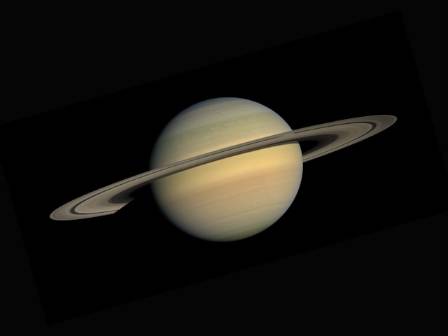
Among all the planets orbiting the Sun, Saturn possesses a unique allure. Wrapped in magnificent rings that gleam against the darkness of space, it appears less like a planet and more like a masterpiece suspended in the cosmos. Its graceful appearance has fascinated skywatchers for centuries, making it one of the most recognizable and admired objects in our solar system.
Yet Saturn is far more than a beautiful sight. Beneath its elegant exterior lies an immense world of swirling storms, crushing pressures, and intricate celestial relationships involving dozens of moons. Studying Saturn provides valuable insight into the formation of planets, the evolution of solar systems, and the forces that govern our universe.
Humanity’s First Encounters with Saturn
Saturn has been observed since ancient times because it shines brightly enough to be seen without any optical instruments. Early civilizations noticed its slow movement among the stars and often linked it to concepts such as time, endurance, and recurring cycles.
The Romans named the planet after Saturn, their god associated with agriculture and the passage of time. Other cultures gave it different names and meanings, but it consistently held an important place in the night sky.
A major breakthrough came in the early 1600s when Galileo Galilei first examined Saturn through a telescope. He noticed unusual protrusions on either side of the planet but could not determine their true nature. Saturn appeared unlike any other planet he had observed.
Several decades later, Christiaan Huygens correctly concluded that these mysterious structures were rings encircling the planet. This revelation transformed Saturn into one of the most intriguing objects in astronomy.
As telescopic technology advanced, scientists discovered that the rings were not solid bands but vast collections of countless particles. Saturn soon became a key subject in planetary science and celestial mechanics.
Saturn’s Location and Size
Saturn occupies the sixth orbital position from the Sun and resides roughly 1.4 billion kilometers away. It lies beyond the asteroid belt and Jupiter, within the outer reaches of the solar system.
Measuring approximately 120,000 kilometers across, Saturn ranks as the second-largest planet after Jupiter. Its enormous volume could contain more than 760 Earth-sized worlds.
Despite its tremendous size, Saturn is surprisingly low in density. If a body of water large enough existed, Saturn would theoretically float. This unusual characteristic stems from its composition, which consists primarily of hydrogen and helium.
These same elements dominate the Sun and exist in various forms inside Saturn, ranging from gases near the top of the atmosphere to liquid and metallic states deep within the planet.
Completing one orbit around the Sun requires about 29.5 Earth years. As a result, each season on Saturn lasts more than seven years, producing gradual but dramatic changes in the way sunlight illuminates its ring system.
Internal Structure and Composition
Although Saturn appears smooth and uniform from afar, its interior is highly complex. Unlike Earth, Saturn lacks a clearly defined solid surface.
Its outer atmosphere contains cloud layers primarily composed of ammonia ice crystals. These clouds form visible bands that wrap around the planet and are driven by powerful atmospheric currents.
Deeper inside, temperatures and pressures increase significantly. Hydrogen gas gradually transitions into liquid hydrogen, and farther down it may become metallic hydrogen, a highly conductive state that contributes to Saturn’s magnetic field.
At the center likely sits a dense core consisting of rock, metals, and ice. While relatively small compared to the planet's overall size, this core contains a substantial portion of Saturn's mass.
Rather than distinct boundaries between layers, Saturn features gradual transitions where pressure and density steadily increase toward the center.
The Famous Ring System
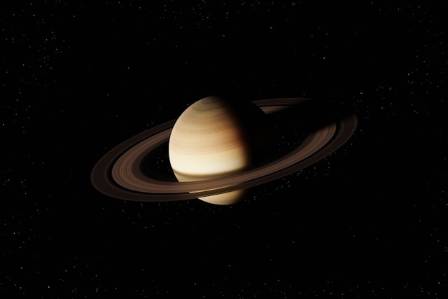
Saturn’s rings are undoubtedly its most iconic feature.
Stretching hundreds of thousands of kilometers outward from the planet, the rings appear immense in width but are remarkably thin, often measuring only tens of meters from top to bottom.
The rings consist mainly of water ice mixed with dust and rocky debris. Individual pieces range from microscopic particles to chunks larger than buildings.
Rather than forming a solid structure, each particle follows its own orbit around Saturn. Together, they create the spectacular ring system visible from Earth.
Scientists classify the rings into several major sections, including the prominent A, B, and C rings, along with fainter outer rings labeled D, E, F, and G.
Throughout the rings are countless gaps, ripples, and patterns created by gravitational interactions. Small moons orbiting nearby often shape these structures. Known as shepherd moons, they help maintain the rings' organization and prevent material from dispersing.
Researchers continue to debate the rings' origin. One possibility is that they formed when a moon or comet ventured too close and was torn apart by Saturn's gravity. Another theory suggests they are remnants left over from the planet’s formation.
Whatever their beginning, the rings are not permanent. Observations indicate they are slowly losing material and may eventually vanish over astronomical timescales.
Weather and Atmospheric Activity
Saturn’s atmosphere is far more dynamic than its calm appearance suggests.
Like Jupiter, Saturn displays broad atmospheric bands created by rising and sinking gases. These regions differ slightly in color and brightness, giving the planet its distinctive striped appearance.
Some of the fastest winds in the solar system race through Saturn’s atmosphere, reaching speeds of nearly 1,800 kilometers per hour. These winds fuel enormous storms that can persist for months or even years.
One of Saturn’s most unusual features is the giant hexagon located at the north pole. This six-sided atmospheric structure has remained remarkably stable since its discovery and continues to puzzle scientists.
Lightning storms also occur frequently. Some are powerful enough to produce radio signals detectable by spacecraft.
Conditions throughout the atmosphere vary dramatically. The upper layers are extremely cold, while temperatures and pressures rise sharply deeper within the planet.
Saturn’s Remarkable Family of Moons
Saturn possesses an extraordinary collection of natural satellites. More than 140 moons have been identified, making Saturn the planet with the greatest number of known moons.
Among them, Titan stands out as one of the most fascinating worlds in the solar system. Larger than Mercury, Titan possesses a thick nitrogen-rich atmosphere and hosts rivers, lakes, and seas composed of liquid methane and ethane.
Another scientifically important moon is Enceladus. Beneath its icy shell lies a global ocean, and giant plumes of water vapor erupt from fractures in its surface. These discoveries make Enceladus a prime target in the search for extraterrestrial life.
Other moons, including Rhea, Dione, and Iapetus, display diverse geological features and unique histories. Some are heavily cratered, while others exhibit unusual surface patterns and color differences.
The interactions between Saturn and its moons help shape the ring system and contribute to the stability of the entire Saturnian environment.
Space Missions to Saturn
Much of our modern knowledge about Saturn comes from robotic exploration.
The most influential mission was Cassini, a spacecraft launched in 1997 that arrived at Saturn in 2004. For over thirteen years, it conducted an extensive study of the planet, its rings, and its moons.
Cassini provided unprecedented observations of atmospheric storms, ring structures, and magnetic phenomena. It also delivered groundbreaking discoveries about Titan and Enceladus.
Scientists confirmed methane lakes on Titan and detected water-rich geysers erupting from Enceladus, revealing environments that may possess ingredients necessary for life.
In 2017, Cassini concluded its mission by intentionally diving into Saturn’s atmosphere. This final maneuver prevented contamination of potentially habitable moons while gathering valuable scientific data during its descent.
Why Saturn Matters to Science
Saturn serves as an important natural laboratory for understanding planetary systems.
Investigating its structure helps scientists learn how giant planets form and evolve. Its rings provide a nearby example of disk dynamics, offering clues about the processes that create planets around young stars.
The planet’s moons are equally valuable. Titan and Enceladus, in particular, have become central targets in the search for environments capable of supporting life.
Through Saturn, researchers connect disciplines ranging from astronomy and physics to chemistry and astrobiology.
Saturn’s Enduring Appeal
Beyond its scientific significance, Saturn occupies a special place in human imagination.
Its magnificent rings create a sense of elegance unmatched by any other planet. Even viewed through a small telescope, Saturn often leaves first-time observers astonished.
Seeing such a distant world with visible rings provides a powerful reminder of the vastness and beauty of the cosmos.
Saturn inspires curiosity, exploration, and wonder. It encourages us to look beyond our own world and seek a deeper understanding of the universe.
The Next Chapter of Exploration
Future missions will continue uncovering Saturn’s secrets.
Scientists are especially eager to return to Titan and Enceladus with advanced spacecraft capable of analyzing their environments in greater detail. Such missions could dramatically improve our understanding of habitability and the potential for life elsewhere.
New technologies may also enable more detailed studies of Saturn’s atmosphere and rings, perhaps even allowing direct sampling of ring material.
As exploration advances, Saturn will undoubtedly continue surprising us with new discoveries.
Conclusion
Saturn is one of the most extraordinary worlds in the solar system. Its dazzling rings, powerful storms, and diverse collection of moons combine to create a planetary system of exceptional beauty and complexity.
Studying Saturn reveals important insights into planetary formation, atmospheric science, and the possibility of life beyond Earth. At the same time, its striking appearance continues to inspire generations of observers.
Glowing softly beneath its magnificent rings, Saturn remains a symbol of cosmic beauty, scientific discovery, and the endless mysteries that await us in the universe.
संबंधित

About The Venice Canal
The Venice Canals community is situated in the Venice neighborhood of Los Angeles, only a few blocks away from the famous Venice Beach. Located south of Santa Monica, north of Marina del Rey, and just east of the Pacific Ocean and the well-known Venice Beach Boardwalk, the canals offer a peaceful historic setting within one of Los Angeles’ most vibrant coastal areas.

मनमोहक फेल्ट कलाकृति बनाना: अनोखे सॉफ्ट टॉय बनाने के लिए एक DIY गाइड
प्यारे फेल्ट आर्टवर्क बनाना आपके घर में हस्तनिर्मित आकर्षण लाने का एक शानदार तरीका है। ये मुलायम और स्पर्शनीय रचनाएँ बच्चों और बड़ों दोनों के लिए उपयुक्त हैं, जो रचनात्मकता को व्यक्त करने का एक बेहतरीन अवसर प्रदान करती हैं और परिणामस्वरूप एक मनमोहक, आलीशान कलाकृति तैयार होती है। चाहे आप त्योहारों के लिए कोई सजावट बनाना चाहते हों या साल भर बच्चों के कमरे की सजावट के लिए कोई सुंदर वस्तु, फेल्ट की सादगी इसे कलात्मक अभिव्यक्ति का आदर्श माध्यम बनाती है।

What Is a Traditional Breakfast? A Global Journey Through Morning Meals
Breakfast is more than the first meal of the day—it’s a cultural mirror that reflects a region’s history, geography, and values. From the hearty fry-ups of England to the delicate miso soup of Japan, traditional breakfasts around the world are as diverse as the people who enjoy them. They can be a quick, on-the-go bite or a leisurely family feast, a simple bowl of grains or an elaborate spread of local specialties. But what unites all traditional breakfasts? It’s their ability to nourish both body and community, to mark the start of the day with intention and flavor. In this exploration, we’ll traverse continents to discover the stories, ingredients, and rituals behind some of the world’s most beloved morning meals, and examine how these traditions evolve while staying rooted in culture.

Robots Designed Like Animals
Humans have become remarkably skilled at building machines that imitate the structure and movement of animals.

Dyson Introduces the Powerful and Serenely Quiet Purifier: A Revolutionary Air Filtration Marvel
Dyson has been relentlessly impressing us with a flurry of innovative product announcements, and its latest unveiling, the Dyson Purifier Big+Quiet Formaldehyde, continues to demonstrate their unceasing commitment to redefining air purification.

Best Sports Cars in 2026
Sports cars represent a dream for many drivers, delivering excitement and performance that everyday vehicles simply can’t match. Although interest in this segment has cooled slightly, there are still plenty of excellent options available—some even at relatively affordable prices. Below is a refreshed guide to the top sports cars you can buy in 2025, along with helpful insights to guide your decision.